St. Bartholomew’s Conservancy and St. Bartholomew’s Church have jointly selected Amanda Trienens to serve as the Triple Portal Conservation Project’s Lead Conservator. Ms. Trienens is Founding Principal of Cultural Heritage Conservation LLC (CHC) based in Chatham, New York. She has more than 20 years of field experience working on historic structures, monuments, and sculptures. The firm’s overarching goal is to ensure the longevity of our shared cultural heritage while attending to the needs and expectations of a spectrum of clients. Philosophically, CHC projects are known for embracing (i) maximum retention of original materials, (ii) (recommending repairs whose durability derives from being mechanically compatible with those materials; (iii) specifying conservation treatments that are both effective and minimally invasive, and (iv) drawing attention to the public significance of heritage conservation projects. While offering a full array of design development and testing services, the firm is also uniquely equipped to manage conservation implementation.
Concurrent with her role as Principal of CHC, Ms. Trienens is an Adjunct Assistant Professor at the Columbia University Graduate School of Architecture, Planning and Preservation. She holds a master’s degree in Historic Preservation and an Advanced Conservation Certificate from the University of Pennsylvania School of Design. Ms. Trienens serves on the Board of the Association for Preservation Technology (APT) - Northeast Chapter, is a Professional Associate of the American Institute for Conservation (AIC), and is a member of the International Institute for Conservation. She lectures and teaches throughout the country, focusing particularly on the implementation of conservation treatments.
Other current projects in the CHC Portfolio include the 9/11 Museum Slurry Wall, the Alamo Church in San Antonio, several artworks in a private Hudson Valley collection, and two McKim Mead & White buildings on college campuses. Completed projects include work on Boston’s Robert Shaw Gould Memorial, a collaboration between Augustus St. Gaudens and Stanford White, and in New York City work on the Metropolitan Museum of Art, the former Met Breuer Museum, the Joan of Arc and Farragut Monuments, and the Heinrich Heine (Lorelei) Fountain sculpted by Ernst Herter. For its work on the Met Breuer Museum, CHC received a Lucy Moses Preservation Award, the New York Landmarks Conservancy’s highest honor.
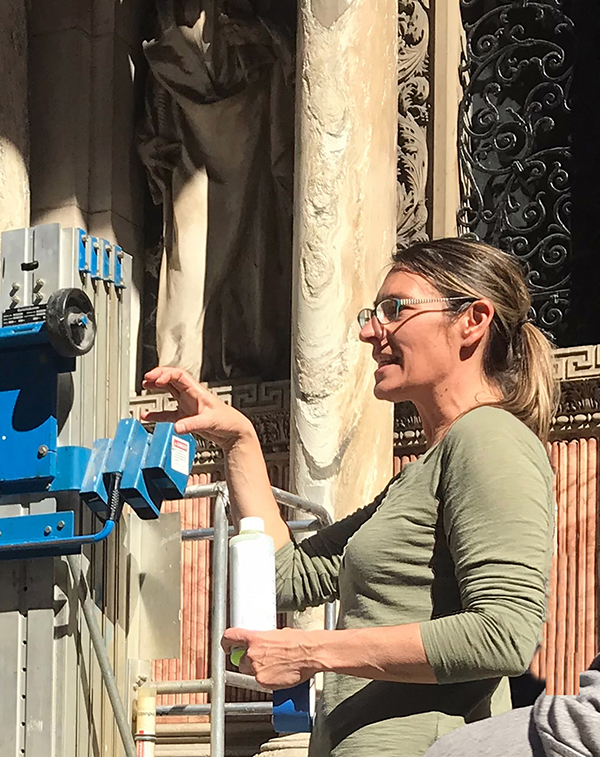 Amanda Trienens, Principal & Owner, Cultural Heritage Conservation, LLC, on-site. |
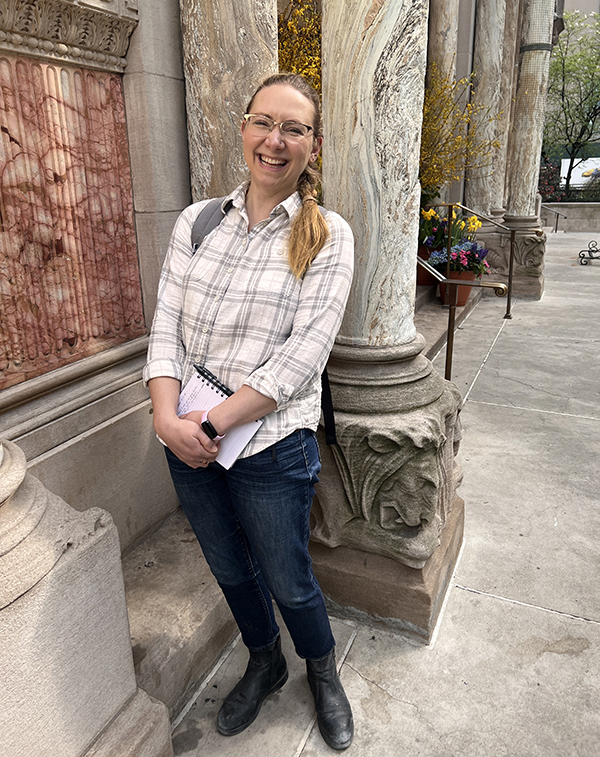 On the CHC Team, Julianne Wiesner-Chianese specializes in stone sculpture, monuments, and structures. |
Stanford White Triple Portal: Conservation Program
The main entrance to St. Bartholomew’s Church, a National Historic Landmark on Park Avenue between 50th and 51st Streets in New York City, is a monumental freestanding work of art in stone and bronze. Designed by legendary architect Stanford White, it consists of three pairs of bronze doors cast in deep bas relief surrounded by richly carved stone arches and twenty-four (once colorful) marble columns inserted among delicately sculpted limestone friezes and marble tympana. Known historically as the “Stanford White Triple Portal,” it was commissioned in 1900 by Alice Gwynne Vanderbilt and her daughter, Gertrude Vanderbilt Whitney, as a memorial to Mrs. Vanderbilt’s late husband, Cornelius Vanderbilt II. It was originally installed as the entrance to the previous St. Bartholomew’s on Madison Avenue at 44th Street. In 1918, when the congregation moved to Park Avenue, Mrs. Vanderbilt arranged for the Triple Portal to be brought to the new site, where it profoundly influenced Architect Bertram Goodhue’s design for the Park Avenue church. At the time, Goodhue himself characterized it as the most beautiful thing of its kind in America.
Decades of weathering and exposure to air pollution, microbial colonization, and vibrating underground trains have not been kind to the Triple Portal. Yet, at its core, it remains a singular confluence of multiple generations of architectural and artistic brilliance, historic materials and technologies, and a sumptuous composition that is at once subtle and powerful. While its status as an irreplaceable work of art is undeniable, that it warrants skillful conservation is equally apparent. Awareness of that is growing as evidenced by the substantial grant recently awarded St. Bartholomew’s Conservancy by the Save America’s Treasures Program of the Historic Preservation Fund administered by the National Park Service, Department of the Interior.
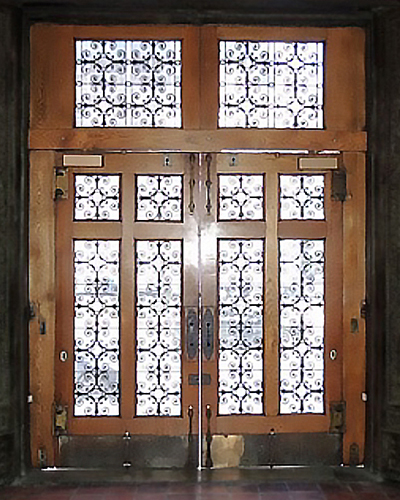
Conservation of the Triple Portal includes four major components: Cipollino Marble Columns, Iconographic Sculpture, Bronze Doors, and Limestone Steps. Additionally, Wooden Pocket Doors that protect the Bronze Doors will be restored and Exterior Lighting will be installed.
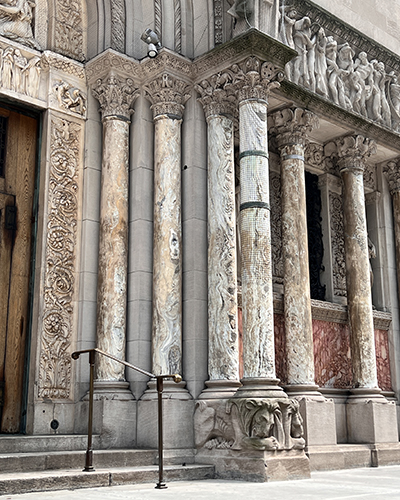 Cipollino Marble Columns Cipollino Marble Columns
|
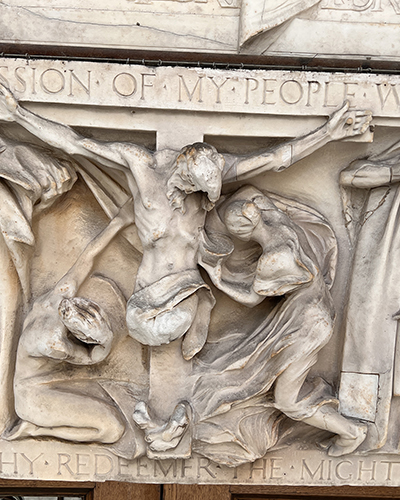 Iconographic Sculpture Iconographic Sculpture
|
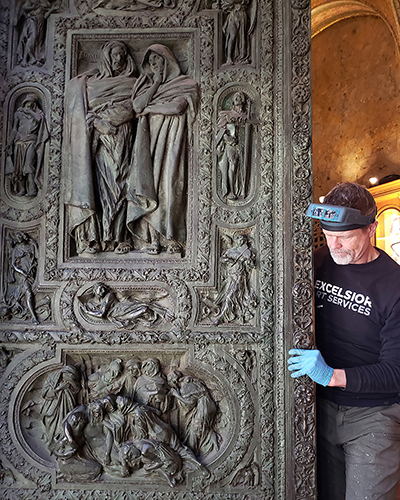 Bronze Door Bronze Door
|
||
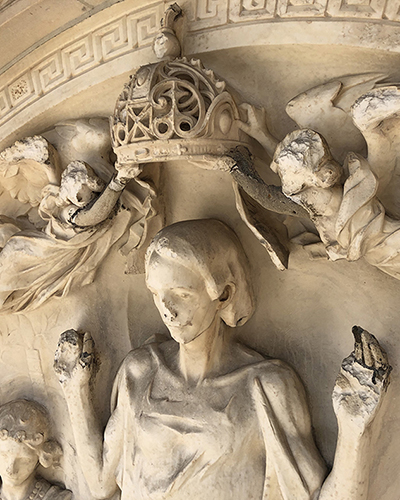 Detail Center Tympanum Detail Center Tympanum
|
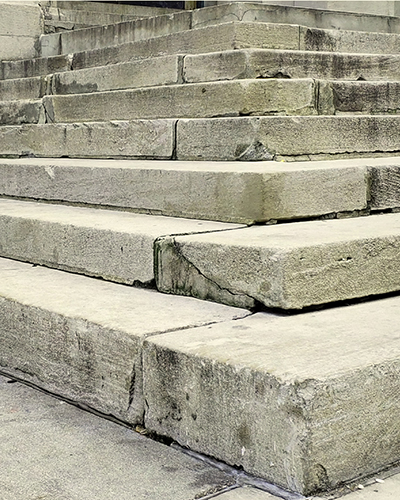 Limestone Steps Limestone Steps
|
 Wooden Pocket Doors Wooden Pocket Doors
|
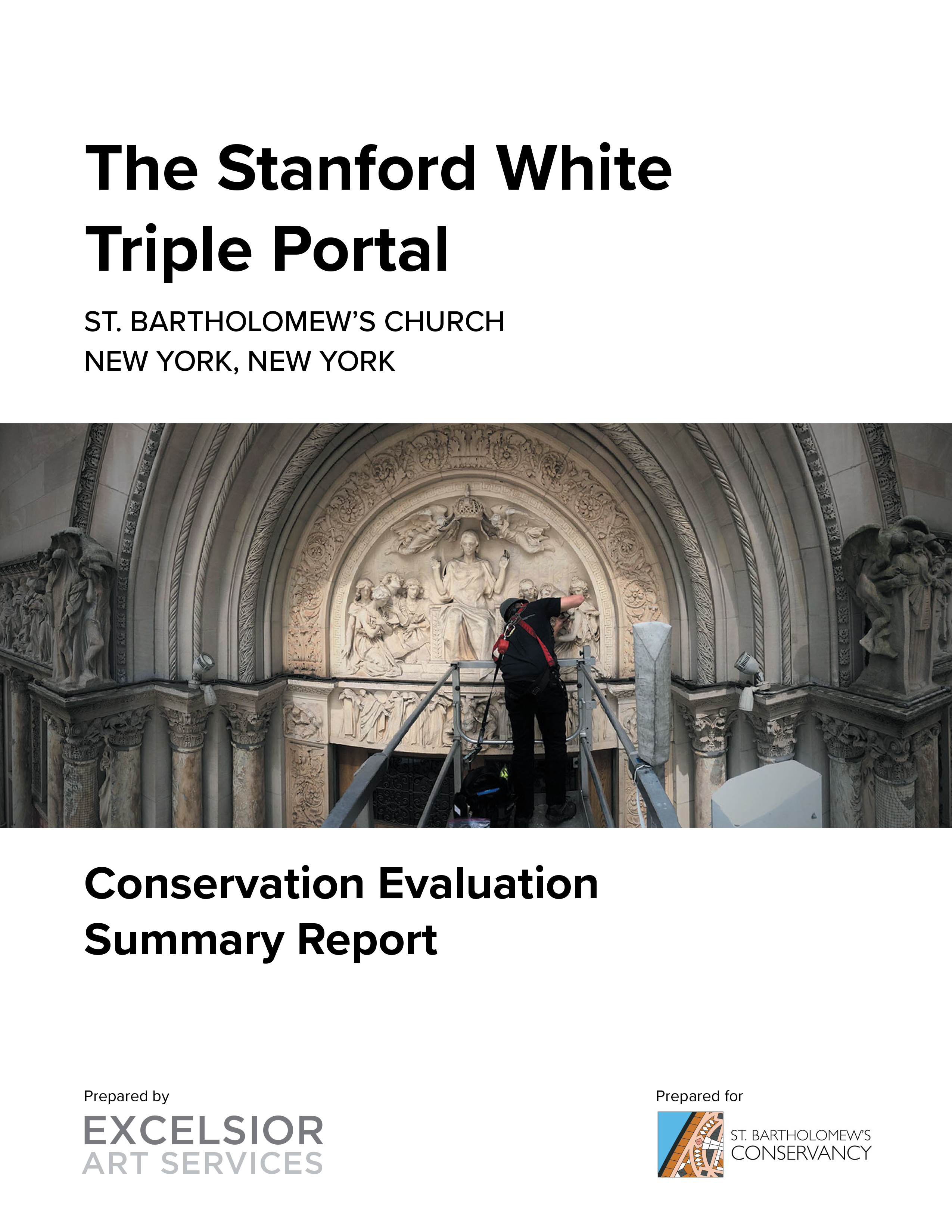
Important preliminary work on the Triple Portal has been completed, and more is underway. In November 2022, the Conservancy engaged Excelsior Art Services to conduct a thorough conservation evaluation of the Triple Portal. Excelsior recommended an array of conservation techniques that are now being field tested by the Project’s recently engaged Lead Conservator, Amanda Trienens, Cultural Heritage Conservation LLC.
St. Bartholomew’s Conservancy is currently seeking the funds still needed to assure a Triple Portal conservation program of the highest quality that meets the Secretary of the Interior's Standards and Guidelines for Historic Preservation and the National Historic Preservation Act. The goal is to stabilize the Portal and, to the extent possible, return it to its original beauty without compromising its authenticity. To protect it for the enjoyment of future generations, a Long-term Maintenance Program is also included. Collateral benefits are expected to be many, including adding to the beauty of Park Avenue, advancing knowledge of conservation treatments, and, by taking advantage of newsworthy moments in the conservation process (e.g., when marble columns are being removed for off-site treatment or returned after treatment) encouraging visits to the site and generally enhance public appreciation of the importance of cultural heritage preservation.