
St. Bartholomew's Church: Three locations in New York City
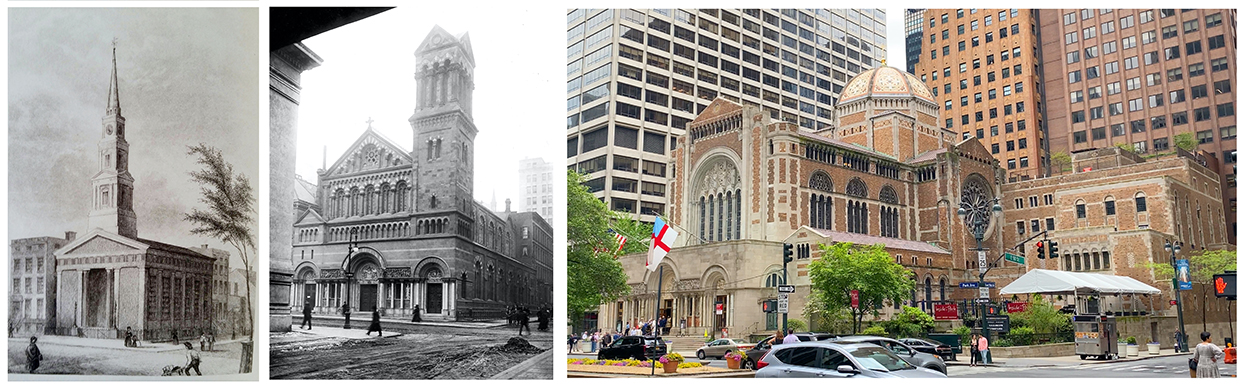
1835: Great Jones Street and Lafayette Place; 1872: Madison Avenue at 44th Street; and 1918: Park Avenue at 50th Street.
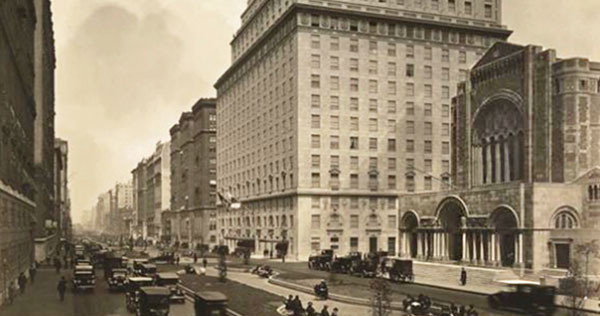
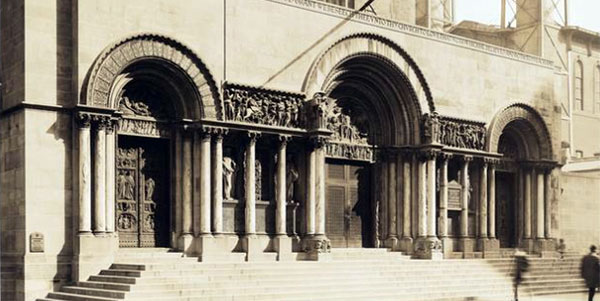
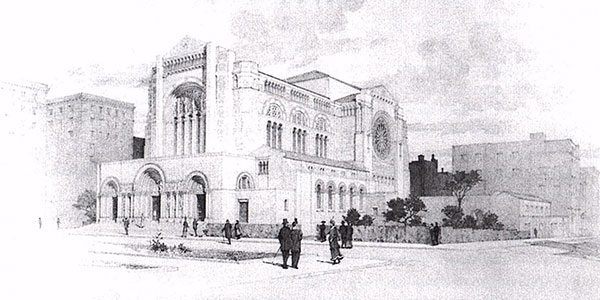
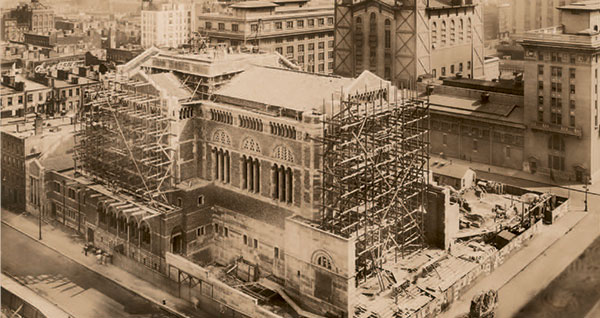
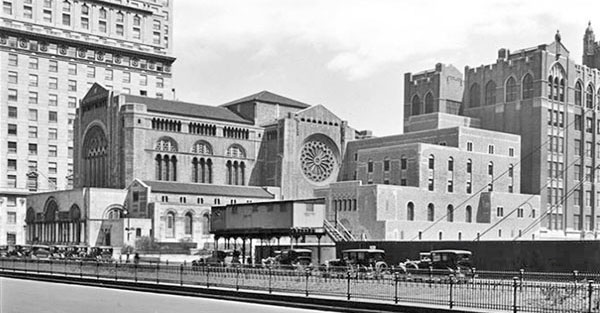
St. Bartholomew's Church on Park Avenue.
Historical Timeline
| 1835 | St. Bartholomew’s Church is founded and builds a simple, Colonial-style sanctuary at the corner of Great Jones Street and Lafayette Place. |
|---|---|
| 1872 | St. Bartholomew’s moves to a new building designed by James Renwick, Jr. at Madison Avenue and 44th Street. |
| 1888 | St. Bartholomew’s opens its 42nd Street Parish House, offering a large immigrant population English language classes, employment and loan bureaus, boys’ and girls’ clubs, chapel and a clinic later expanded into a full-fledged hospital. |
| 1900 | Alice Gwynne Vanderbilt (Mrs. Cornelius Vanderbilt II) commissions Stanford White to design a Triple Portal for the Madison Avenue Church. White, in turn, commissions renowned American sculptors Daniel Chester French, Andrew O’Connor, Philip Martiny, and Herbert Adams to create the Portal’s Bronze Doors and Sculptural Friezes that were completed in 1903. |
| 1905 | Leopold Stokowski is hired as St. Bartholomew's Organist and Choirmaster. The Choir is unusual in its day, both because of its size and because it includes female voices. |
| 1914 | The St. Bartholomew’s congregation engages celebrated architect Bertram Grosvenor Goodhue to design a new church on Park Avenue. Goodhue’s design is to include the Stanford White Triple Portal, which will be moved to the new site. |
| 1918 | The St. Bartholomew’s congregation moves to Park Avenue. |
| 1928 | The 42nd Street Parish House is sold. A new Community House goes up on the Park Avenue site. It becomes the home of a non-denominational Community Club ministering to young professionals. |
| 1930 | The iconic Great Dome is added. The church interior has been finished with architectural sculpture by Lee Lawrie in 1925 and mosaics by Hildreth Meière in 1929. |
| 1967 | The St. Bartholomew’s site is designated a New York City Landmark. |
| 1980 | The St. Bartholomew’s site is listed on the National Register of Historic Places. |
| 1981 | The “Battle for St. Bart’s” erupts over a proposal to replace the Community House with an office tower. The U.S. Supreme Court resolves the matter in favor of the New York City Landmarks Preservation Commission, supported by such notables as Brooke Astor, Jacqueline Kennedy Onassis and Brendan Gill. |
| 1992 | The St. Bartholomew’s Preservation Foundation is established by St. Bartholomew’s Church. |
| 2008 | After a two-year fund drive, restoration of the St. Bartholomew’s site begins. Leaking roof drains are made watertight, the iconic Dome is temporarily secured, and the Great Terrace and 50th Street parapet wall are rebuilt. “Inside Park,” the site’s popular new restaurant, opens. |
| 2011 | The St. Bartholomew's Preservation Foundation is re-organized as the entirely independent St. Bartholomew's Conservancy. |
| 2015 | St. Bartholomew’s Conservancy prepares and submits the nomination for National Historic Landmark status for St. Bartholomew’s Church. The National Park Service Advisory Board unanimously recommends that the site be so designated, citing its importance as an exceptional work of architecture and art. |
| 2016 | On October 31, 2016, St. Bartholomew’s Church and Community House are designated a National Historic Landmark. Dome restoration is underway. |
| 2017 | In September 2017, restoration is completed on the Dome. |
| 2019 | Community House restoration begins and is completed in 2020. |
| 2021 | North Facade restoration is completed, and the Great Dome is illuminated. West Facade restoration planning commences. St. Bartholomew’s Conservancy produces a six-part film series, Prodigious Pairings: Past and Present, highlighting the many architects, artists, artisans, and musicians who have had prominent roles in the history of St. Bartholomew’s. |
| 2022 | In May, St. Bartholomew’s Conservancy presents a Gala Organ Concert featuring the Philadelphia Orchestra, renowned for its mastery of the international organ repertoire, in concert with St. Bartholomew’s monumental Aeolian-Skinner pipe organ, the largest such instrument in New York City. The pipe organ is distinguished both by its size and by its unique installation in the church building’s walls and Great Dome. St. Bartholomew’s Conservancy engages Excelsior Art Services, LLC to conduct a comprehensive conservation evaluation of the Stanford White Triple Portal of St. Bartholomew's Church. |
| 2023 | Excelsior Art Services, LLC submits its Conservation Evaluation Summary Report, recommending approaches to consider in developing a plan for Triple Portal conservation. |
| 2024 | In August, St. Bartholomew’s Conservancy is awarded a substantial Save America’s Treasures grant, administered by the National Park Service, Department of the Interior, to support preservation of the Triple Portal. |
| 2025 | In March, Amanda Trienens, founding Principal of Cultural Heritage Conservation, LLC (CHC), assumes the post of Lead Conservator for the Triple Portal project. |
| 2026 | A Masterpiece Hiding in Plain Sight: The Stanford White Triple Portal, a film by St. Bartholomew's Conservancy, is completed, providing the context, inspiration, and fascinating history of this architectural and artistic treasure. |